Little Toomai
The Jungle BookLittle Toomai is the ten-year-old son of Big Toomai and the heir to a family tradition of elephant handling. His defining achievement is not merely that he can work around dangerous animals, but that he crosses a boundary no ordinary human observer has crossed: carried by Kala Nag into the Garo forest, he witnesses the elephants’ secret dance. That experience transforms him from a spirited child tolerated at the edges of the Keddah into “Toomai of the Elephants,” a future tracker publicly honored by elephant catchers and elephants alike.
Identity and Inheritance
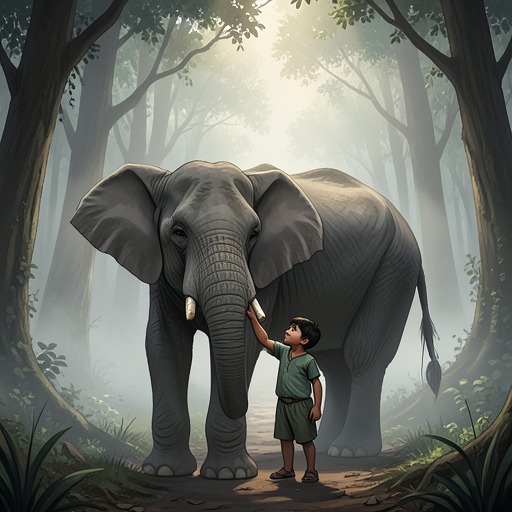
Little Toomai belongs to a line of elephant handlers extending through Big Toomai, his father, and earlier generations. His family’s relationship with Kala Nag is presented as continuous care and accumulated trust: three generations have fed and groomed the elephant, and Big Toomai expects Kala Nag to live long enough to see a fourth. Little Toomai, in turn, has been raised literally under the elephant’s shadow. Before he could walk he played with Kala Nag’s trunk; once he could walk, he led him to water. The inheritance he is expected to receive is practical as well as familial: when grown, he will take his father’s place on Kala Nag’s neck and use the smooth, heavy iron ankus passed down through the family.
His confidence is therefore grounded in experience rather than empty bravado. Little Toomai insists that Kala Nag fears him, and he demonstrates the intimacy behind that claim by approaching the great elephant, insulting him as an “old pig,” and making him lift his feet one after another. Kala Nag’s obedience is not represented as simple domination. The elephant has known the boy since infancy and responds to his sharp little commands with the familiarity of a long-established partnership.
Courage in the Keddah
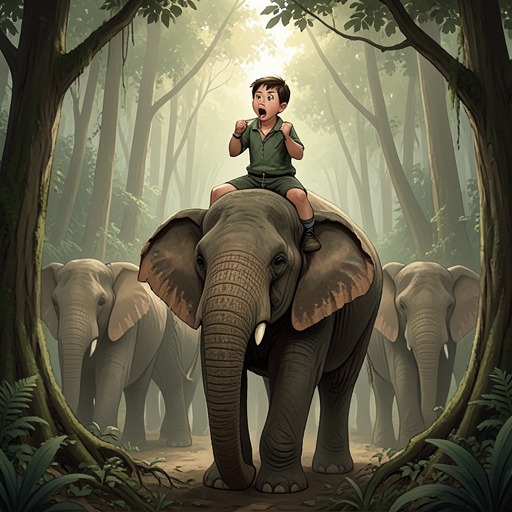
The Keddah is a place of controlled violence, where wild elephants are driven into a stockade and subdued amid trumpeting, torches, ropes, and crashing bodies. Little Toomai is useful there even as a child. He carries a torch, shouts encouragement, and climbs onto a quivering stockade post, where his voice rises above the tumult to direct Kala Nag through the struggle. His cries urge the elephant forward, warn him to be careful, and urge him to strike, while the experienced catchers notice the boy’s intense delight and competence.
His courage becomes dangerous when he slides down from the post and enters the elephants’ midst to help a driver secure a kicking calf. Kala Nag sees him, catches him with his trunk, and hands him up to Big Toomai. His father slaps him and returns him to the post, then scolds him the next morning for trying to catch elephants on his own. The incident establishes the central tension in Little Toomai’s character: he is fearless because he understands the animals and trusts the bond he shares with Kala Nag, but that same confidence repeatedly carries him beyond the limits imposed by adult authority.
Petersen Sahib recognizes the difference between foolishness and genuine ability. Big Toomai describes his son as a bad boy who may end in jail, yet Petersen Sahib doubts that prediction. A child who can face a full Keddah at Little Toomai’s age, he says, is unlikely to end in jails; he gives the boy four annas for sweetmeats and suggests that he may become a hunter. The praise is immediately qualified by a prohibition: Keddahs are not places for children to play. Petersen Sahib then turns the prohibition into a test, declaring that Little Toomai may enter them freely only after he has seen the elephants dance.
Kala Nag and the Night Journey
The challenge awakens an ambition that adult permission cannot satisfy. One night, after the camp hears the distant call of a wild elephant, Kala Nag becomes restless and stares toward the Garo hills. Big Toomai orders Little Toomai to watch him if he grows unsettled, but the instruction becomes the opening through which the boy follows the animal. When the grass string snaps and Kala Nag slips silently from his pickets, Little Toomai runs after him barefoot, calling for permission to come along.
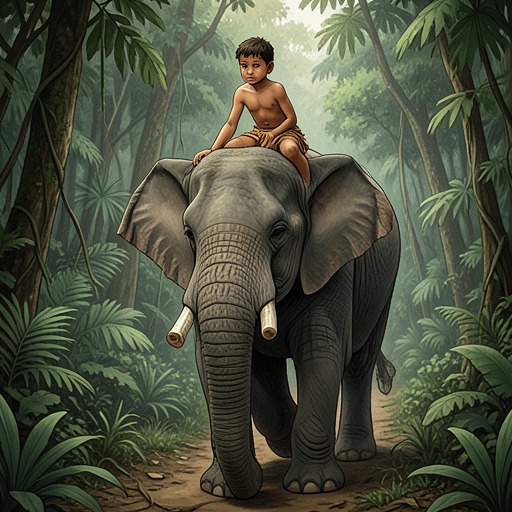
Kala Nag answers the request without noise or hesitation. He turns back, lowers his trunk, lifts Little Toomai onto his neck, and carries him into the forest. The movement changes the boy’s position from worker to chosen passenger. He is no longer merely trying to reach the hidden elephants by his own daring; Kala Nag has accepted responsibility for taking him there. The elephant then travels through the Garo forest with astonishing quiet, climbing through grass, vines, and bamboo while Little Toomai cannot determine the direction from the stars.
The journey places Little Toomai inside a world beyond the camp’s human order. From the elephant’s back he sees the forest spread beneath the moonlight and senses that it is awake and crowded with life. He hears a fruit-eating bat, a porcupine, and a hog-bear digging in the earth. These details make the night less a simple escape than a passage into an autonomous wilderness, one in which the human camp is distant and the elephants follow knowledge inaccessible to their handlers.
Witnessing the Elephants’ Dance
After a long night, Little Toomai returns with Kala Nag and Pudmini to Petersen Sahib’s camp. Kala Nag is footsore, and the boy’s face is gray, his hair filled with leaves and drenched with dew. He nevertheless tries to salute Petersen Sahib and announces that he has seen the dance before fainting from exhaustion. The physical cost of the experience confirms that the achievement is not a child’s easy adventure: he has endured a night journey through the forest and returned barely able to speak.
Once recovered, Little Toomai gives a concise account of what he saw. He insists that the elephants have trampled a larger dance-room and that many tracks lead toward it. His testimony is both personal and verifiable. He invites the men to inspect the newly cleared ground and the numerous tracks, converting a seemingly unbelievable vision into evidence written by the elephants’ feet. The hidden dance thus becomes a value shift in his story: what was previously an unrealized permission and a distant condition becomes accomplished knowledge, and the adults’ judgment of him changes with it.
The scene also reverses the expected direction of observation. Human handlers ordinarily drive, rope, inspect, and discipline elephants; here the elephants lead, and Little Toomai follows. Kala Nag’s authority exceeds the camp’s commands, while the boy’s authority derives from his capacity to attend to that animal knowledge. Little Toomai does not conquer the hidden world. He is admitted into it through trust, endurance, and obedience to Kala Nag’s movement.
Naming and Initiation
Petersen Sahib’s response confirms Little Toomai’s passage into a new social identity. The camp holds a feast, and the boy becomes its hero. Elephant catchers, trackers, drivers, and ropers pass him from one to another and mark his forehead with blood from a jungle-cock, identifying him as a forester initiated into the jungles. The bodily mark formalizes what his actions have already demonstrated: he is no longer merely a child accompanying his father’s work.
The decisive renaming comes from Machua Appa, the head of the Keddah drivers. He declares that the boy will no longer be called Little Toomai, but Toomai of the Elephants, echoing the name carried by his great-grandfather. The new name joins personal achievement to ancestral continuity. Little Toomai has not abandoned inheritance; he has proved worthy of its highest title by seeing what no human being had seen through the long night.
Machua Appa’s proclamation gives the initiation a future as well as a present meaning. He predicts that Toomai of the Elephants will become a great tracker, able to distinguish new, stale, and mixed trails, and will move safely in the Keddah among wild tuskers. The promise is not abstract praise. It imagines a specific adult vocation built from the capacities already visible in the boy: alertness, courage, knowledge of elephant behavior, and the protection afforded by his recognized bond with the animals.
Narrative Role and Significance
Little Toomai’s arc follows a discovery-and-maturation pattern, but its discovery is also a ceremonial recognition. He begins as a child whose daring is treated as disobedience, is tested by Petersen Sahib’s condition, and fulfills that condition through an act made possible by Kala Nag’s trust. His achievement does not consist in defeating the elephants. It consists in entering their hidden order without destroying it and returning as a credible witness.
The story repeatedly contrasts human classification with lived relationship. Adults can call Little Toomai a bad boy, a future hunter, or a child forbidden to enter the Keddah; the elephants respond to him through memory and recognition. The final ceremony brings these systems together. Human society marks and renames him, while the elephants answer the proclamation by raising their trunks in the Salaamut of the Keddah. The salute makes his new identity collective: Toomai of the Elephants is honored not only by the people who work with elephants, but by the line of animals whose hidden dance established his distinction.
His significance therefore lies in the way childhood is transformed without being erased. The reckless boy who slips into danger remains the source of the future tracker’s courage, but his daring is given meaning by discipline, inheritance, and the consent of Kala Nag. The final name records a reciprocal relation rather than a human victory: Little Toomai becomes Toomai of the Elephants because he has learned to follow where the elephants lead.